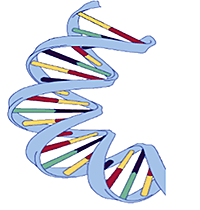
All living things, bananas and people included, pass on information from one generation to the next using the same basic material, DNA. Within every living organism, most cells contain a complete set of DNA instructions. The information in DNA tells our bodies how to develop, grow, and work. It also controls many of the features that make an organism unique.
DNA or deoxyribonucleic acid is found in all living things. Its natural shape is called a double helix and when seen under extremely high-powered microscopes, it looks kind of like a ladder twisted into a spiral shape.
These instructions are in segments of DNA called genes. Genes, along with other parts of our DNA that turn genes on and off, hold information for how our body develops and functions. They produce molecules called proteins that do most of the work in the body. Variants of genes, called alleles, are responsible for differences in hair colour, eye colour, and earlobe shape.
All of these instructions fit within tiny packages within our tiny cells, so that is all way too tiny for anyone to ever really see or touch, right? Well, not entirely. Because DNA is in every cell, there is a lot of it in an organism. If you took all of the DNA out of some middle-sized organism (or part of an organism, like a piece of fruit), you could see and even touch DNA. We will use common household products to break apart the cells in a banana and extract out the DNA. While you may know of the double-helix structure of DNA, you can't see that structure with the naked eye. So when seeing it without a high-powered microscope...what does DNA look like?
All of these instructions fit within tiny packages within our tiny cells, so that is all way too tiny for anyone to ever really see or touch, right? Well, not entirely. Because DNA is in every cell, there is a lot of it in an organism. If you took all of the DNA out of some middle-sized organism (or part of an organism, like a piece of fruit), you could see and even touch DNA. We will use common household products to break apart the cells in a banana and extract out the DNA. While you may know of the double-helix structure of DNA, you can't see that structure with the naked eye. So when seeing it without a high-powered microscope...what does DNA look like?
Materials 
- 1/2 peeled ripe banana (you can also use strawberries or other fruit)
- 1/2 cup hot water
- 1 tsp salt
- 1/2 tsp liquid dishwashing soap
- resealable zip-top bag (quart size)
- very cold rubbing alcohol (isopropyl alcohol) placed in the freezer ahead of time
- coffee filter
- narrow glass
- wooden stirrer
- Mush the banana in the resealable bag for about a minute until all the lumps are gone and it almost looks like pudding.
- Fill a cup with the hot water and salt.
- Pour the saltwater mix into the bag. Close the bag and very gently squeeze and move the saltwater and banana mush together. Do this for 30 to 45 seconds.
- Add the dishwashing soap into the bag and gently mix the contents. Try to avoid making too much foam.
- Place the coffee filter in a clear glass cup, securing the top of the filter around the lip of the cup.
- Pour the mix into the filter and let it sit until all of the liquid drips down into the cup.
- Remove and discard the used coffee filter.
- Tilt the glass and slowly add cold alcohol down the side of the cup. You want the alcohol to form a layer on top of the banana mix, staying separated, so be careful not to pour it too fast. Make a layer of alcohol that is 2.5-5cm (1-2in) thick.
- After the alcohol layer is set up, wait for eight minutes. You may see some bubbles and cloudy material moving around in the alcohol. This is the DNA pieces clumping together.
- Use the wooden stirrer to start poking the cloudy stuff in the alcohol layer. Spin the stirrer it in place to start gathering the cloudy stuff. When you are done, take a closer look at the stuff on the stirrer. You are looking at DNA!